Move beyond point-in-time vendor security reviews with Nudge Security's new adaptive risk management capabilities: automated app tiering, dynamic risk scoring, and adaptive controls, recommendations, and agentic AI workflows that respond to changes in your third-party risk posture.

Most third-party risk management (TPRM) programs begin with a moment in time: a vendor enters procurement, passes a security review, and gets approved for use with a set of mitigating controls based on the deployment scope and vendor risk assessment.
But almost immediately after, everything changes.
Employees invite other colleagues and external partners to collaborate, connect the app to other critical business apps, and enable AI agents to operate through it to accelerate their work. Meanwhile, the vendor adds data sub-processors, changes its privacy policy, ships new AI features, or experiences a breach.
Even if you’ve been monitoring external vendor risks, the security controls you put in place initially are out of alignment with the reality of your deployment.
To keep up with always-shifting SaaS and third-party AI risks, security teams need a current view of risk that accounts for changing internal usage and access, not just a vendor’s external security posture.
That’s why we built adaptive risk management, generally available now to all Nudge Security customers. Adaptive risk management brings together what Nudge Security knows about a vendor’s security, privacy, compliance, and supply-chain posture with what’s happening inside your own environment. As app usage, access, identities, agents, integrations, app configurations, mitigating security controls, and vendor conditions change, Nudge Security recalculates risk, shows your team where to act, and adjusts built-in policies and controls like security posture checks.
“Nudge provides a relational view across applications, users, integrations, browser extensions, and authentication that surfaces where security actually needs improvement. For example, an organization can have very strong controls in a tool like Slack, but if users connect less-secure third-party apps into it, that can create a breach path without anyone realizing a new risk was introduced. That integrated perspective on risk is what makes Nudge unique.” —Diego Izquierdo, Senior Cybersecurity Engineer, Third Party Risk Management at Mercado Libre
Traditional third-party risk management tools were designed for a highly centralized era of technology adoption. That model assumes that vendors enter through a single, controlled path via IT or procurement intake where they can be inventoried, assessed, and approved before use.
That’s no longer how most technology enters the business. Employees can adopt SaaS and AI tools, create accounts, connect integrations, and grant access to corporate data in minutes. In fact, Nudge Security data shows that about 90% of new apps are introduced by employees outside IT, and only 30–40% of SaaS and AI apps ever pass through vendor security assessments or centrally managed identity controls.
Even known and approved apps evolve after review. Every new integration, AI agent, browser extension, or standalone account can expand an app’s reach without triggering reassessment.
Attackers are taking advantage of these gaps. Recent incidents involving Vercel, Salesloft Drift, and LastPass demonstrate that access granted to one app can create a path into a much broader environment. Third parties are now involved in 48% of breaches, up 60% year over year, according to the 2026 Verizon Data Breach Investigations Report, lending urgency to this concern.
The question is no longer simply, “Is this vendor secure?” Security teams also need to know:
A point-in-time vendor security review can’t answer those questions on its own. Neither can continuous risk monitoring that separates vendor risk from internal usage context.
Nudge Security already discovers the SaaS and AI tools your workforce uses, including the apps and instances that never went through procurement. Our new adaptive risk management capabilities turn that inventory into a living view of business criticality and risk that drives risk recommendations and mitigating controls.
Here’s what that looks like in practice.
No security team can give every app the same level of scrutiny—nor should they. A large enterprise may have thousands or tens of thousands of SaaS and AI apps in use. Applying a heavyweight security review to every one of them is unrealistic, but teams often don’t have enough information to prioritize their review efforts appropriately when an app is first introduced.
Nudge Security gives security teams a consistent, practical way to decide where deeper review and stronger controls are warranted. It automatically assigns each app a business criticality tier: critical, high, medium, or low. This tier is based on how broadly the app is used across the organization and how sensitive the data it typically handles is, which reflects what’s at stake if the app is compromised. To assess data sensitivity consistently across all apps, Nudge Security uses a proprietary AI model to infer up to 29 data types each app typically handles, then maps those data types to sensitivity tiers that customers can customize to align with their own internal data governance models.
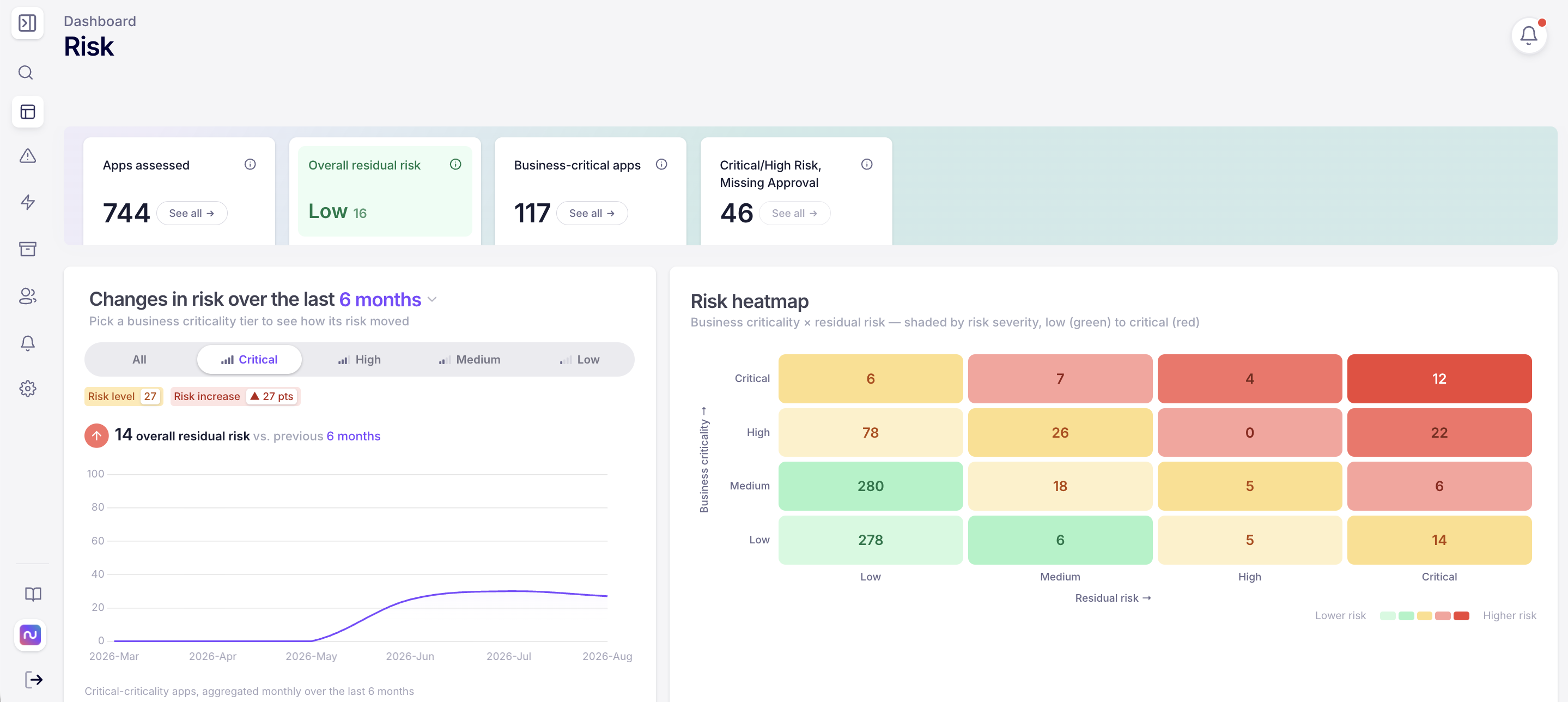
Our risk dashboard pairs business criticality with app risk scores in a visual heatmap, making it easy to weigh risk and impact as you assess risk concentration across your entire SaaS and AI estate.
For each SaaS or AI app, Nudge Security calculates a dynamic risk score from more than 30 internal and external factors, drawn from a combination of rich internal usage context and insights from a self-populating database of more than 250,000 SaaS and AI vendor security profiles. For example, risk factors include:
Because app risk scores don’t rely on vendor participation, privileged trust assets, manual data entry, or prior knowledge that an app is in use, Nudge Security can begin assessing risk as soon as an app appears and continually recalculate scores as risk factors change.
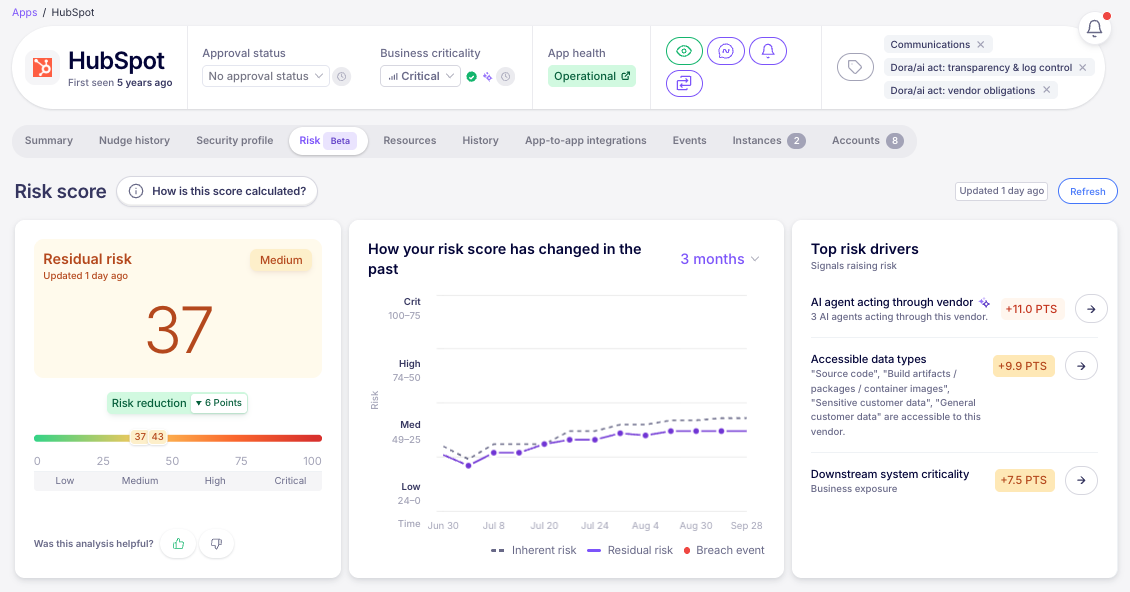
Nudge Security provides a detailed breakdown of the factors driving each score within the Risk tab for each SaaS or AI app. As app risk scores change, teams can quickly understand which factors contributed without starting a new investigation from scratch.
The controls appropriate for an app should depend on the role it plays today, not the role it played when it was first approved. Nudge Security helps teams adapt by connecting changes in business criticality and risk to the controls that matter most.
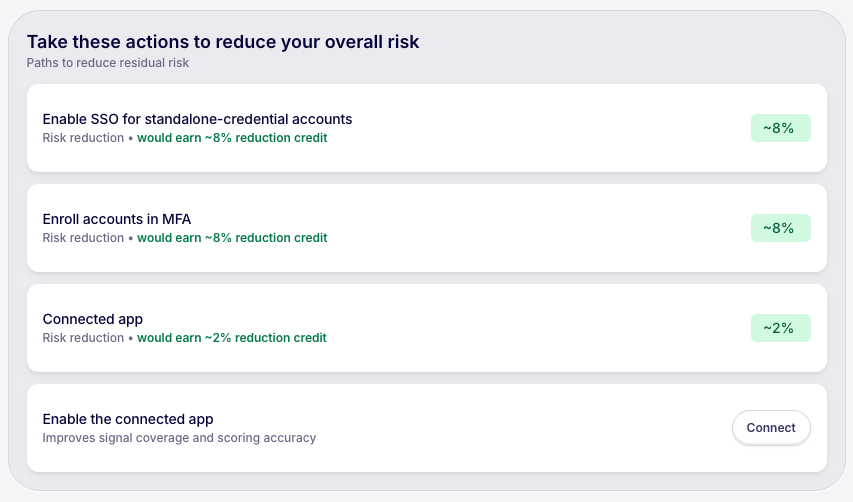
Within the Risk tab for each app, Nudge Security ranks the control gaps that contribute most to risk so teams know what to fix first. As app risk or criticality changes, Nudge Security equips teams to enable stronger authentication requirements, expand security posture monitoring automatically, trigger reviews of high-risk OAuth grants with the Nudge Security OAuth Risk Analyst AI agent, or route remediation to the appropriate app owner, administrator, or user. Native controls, policy-driven nudges, agent-powered workflows, and third-party security integrations make it possible to put those decisions into practice at scale.
The result is a control strategy that stays proportional to your actual SaaS and AI risk—stronger where exposure is growing and lighter where it's limited. It's also auditable and changes as the facts change.
Employees will keep adopting applications, connecting integrations, and experimenting with AI. Vendors will keep changing their products, data privacy policies, sub-processors, and security posture. That isn’t going away, and trying to force every technology decision back through a centralized process will only create more workarounds.
The only path forward is to make risk visible as it changes, give security teams enough context to prioritize it, and apply the right control at the right time, enabling your third-party risk program to adapt as quickly as the environment it protects.
Adaptive risk management is available now to all Nudge Security customers.
Ready to move beyond point-in-time vendor reviews? Request a demo to see how Nudge Security keeps SaaS and AI risk visible, prioritized, and under control.