As employees rapidly adopt SaaS and AI outside formal procurement, traditional point-in-time reviews struggle to keep pace with changing third-party risk and reveal how apps are actually used. Nudge Security combines external vendor intelligence with internal context such as app usage, access, identities, integrations, configurations, and controls to help security teams respond dynamically to evolving risks.

Nudge Security provides adaptive risk management for third-party SaaS and AI. It continuously combines external intelligence about a vendor’s security, supply chain, privacy, and compliance posture with rich internal risk context from your environment, including app usage, access, identities, OAuth grants, MCP connections, AI agents, configurations, sensitive data, and compensating controls.
Instead of treating risk as a static vendor attribute, Nudge Security evaluates the real exposure created by each app in your environment. As conditions change, Nudge recalculates app risk, identifies the controls with the greatest potential impact, and equips security teams to respond through native controls, policy-driven nudges, guided workflows, and third-party integrations.

Third-party risk management (TPRM) is the practice of identifying, assessing, and mitigating risks introduced by vendors and other third parties.
Most TPRM programs center on formal intake, questionnaires, evidence collection, security ratings, and point-in-time reviews performed during procurement, onboarding, renewal, or after a breach. These approaches can provide valuable vendor assurance, but they usually assume the organization already knows which vendors to assess and that risk can be managed primarily through periodic evaluation of the vendor’s external posture.
That model leaves gaps when employees adopt technology outside formal processes, or when risk changes between reviews.
Nudge Security
Discovers the unknown. Automatically discovers and triages SaaS and AI apps as employees introduce them, delivering a prioritized view of risk.
TPRM
Limited to known vendors. Starts with vendors entering formal intake, procurement, or onboarding. Shadow SaaS and AI remain outside the inventory.
Nudge Security
Context-aware by design. Calculates app risk from both external vendor intelligence and internal usage context, including adoption, access, identities, data, integrations, configurations.
TPRM
Vendor-centric by default. Typically evaluates the vendor as the unit of risk, with limited context about how the organization actually uses or connects the product.
Nudge Security
Always-on. Continuously reassesses risk as vendor posture and internal usage change.
TPRM
Point-in-time. Relies on reviews at onboarding, renewal, annually, or after an incident.
Nudge Security
Dynamically enriched. Draws from proprietary intelligence that includes a self-populating database of 250,000+ SaaS and AI vendor security profiles, without waiting for vendor participation.
TPRM
Evidence ages quickly. Depends heavily on questionnaires, assurance documents, external security ratings, and manually collected evidence that can become stale.
Nudge Security
Internal context built in. Shows who uses each app, which identities and agents have access, what data it may handle, and what controls are in place.
TPRM
External posture in isolation. Focuses on external vendor risks without accounting for changing usage, access, and controls that can magnify that risk.
Nudge Security
Grant-level visibility and control. Continuously discovers OAuth grants and MCP servers, surfaces risk insights and scope details, and enables teams to revoke risky or unused access automatically.
TPRM
Limited visibility beyond the vendor. Most TPRM tools rely on you to provide information about app-to-app connections. OAuth discovery is typically limited to connections with your IdP.
Nudge Security
Exposure-aware response. Connects vendor events to the organization’s actual app usage so teams can identify affected apps, users, integrations, and data pathways and orchestrate a response.
TPRM
Manual impact analysis. May alert on a vendor event, but often requires investigation to determine whether and how the organization is exposed.
Nudge Security
From insight to action. Creates a direct line from risk to action through native controls, policy-driven nudges, guided remediation, human-in-the-loop workflows, and security integrations.
Nudge Security
Static risk registers. Assessments typically end with a risk finding, exception, ticket, or recommended control for another team to (theoretically) implement and verify.
Nudge Security
Built for the long tail. Continuously monitors and triages thousands or tens of thousands of SaaS and AI apps, allowing review depth to match actual risk.
Nudge Security
Built for the compliance audit. Evidence collection and review constrain how many vendors a team can assess and how often assessments can be refreshed.
The risk landscape has moved beyond centralized control. Employees can adopt an app, connect an integration, enable an AI feature, create an agent, or grant access to corporate data without involving IT, procurement, or security. At the same time, vendors add subprocessors, change privacy policies, release new capabilities, experience breaches, and allow assurance documents to expire.
Traditional TPRM programs struggle with this environment for four fundamental reasons:
They assume a centralized adoption model that no longer exists
Traditional TPRM begins with an intake event. But many apps are introduced outside formal processes, creating a mismatch between official vendor inventories and the organization’s actual SaaS and AI footprint. A program cannot assess risks it does not know exist.
They rely on assessments that become outdated almost immediately
A vendor may pass a review today, but tomorrow an employee can connect a high-privilege integration, share sensitive data, add an AI agent, or create an unmanaged account. The vendor can also change its product architecture, subprocessors, policies, or security posture. Annual reassessments and renewal reviews leave long windows where risk changes without a corresponding response.
They separate vendor risk from actual technology usage
The same vendor can create very different risk for two organizations. Exposure depends on who has access, what data the app handles, which identities and systems connect to it, how it is configured, and what controls are in place. External posture alone cannot show the real risk inside your environment.
They can’t scale to the volume and velocity of SaaS and AI adoption
Manual inventories can take months. Evidence collection can take days per app. Human reviews consume hours. When an enterprise uses thousands of third parties, applying the same assessment depth to every app creates backlogs without necessarily reducing the most risk.
Automating questionnaires and evidence collection can make existing TPRM workflows more efficient, but speed alone can’t address underlying gaps. Existing solutions still won’t catch newly-created OAuth grants, unmanaged app instances, or access to sensitive data or critical systems.
Modern TPRM requires more than iterating on static, intake-centric workflows. It requires continuous discovery, continuous context, and a direct connection between changing risk and the controls that can reduce it.
Nudge Security closes the gaps left by point-in-time reviews and static risk scores. It continuously calculates app risk by combining external intelligence about each vendor with rich internal context showing how the app is implemented and connected in your environment.
As risk or business criticality changes, Nudge Security updates app risk, surfaces the control gaps driving that risk, and recommends the actions with the greatest potential impact. Native controls, policy-driven nudges, guided workflows, and third-party integrations help security teams respond at scale while preserving human oversight.
Build a continuously-updated inventory of the SaaS and AI apps your workforce actually uses and automatically tier apps by criticality as soon as they’re introduced, without relying on vendor input, manual data entry, or prior knowledge that the app is in use. Focus deeper review and oversight where exposure is greatest instead of treating every vendor the same.
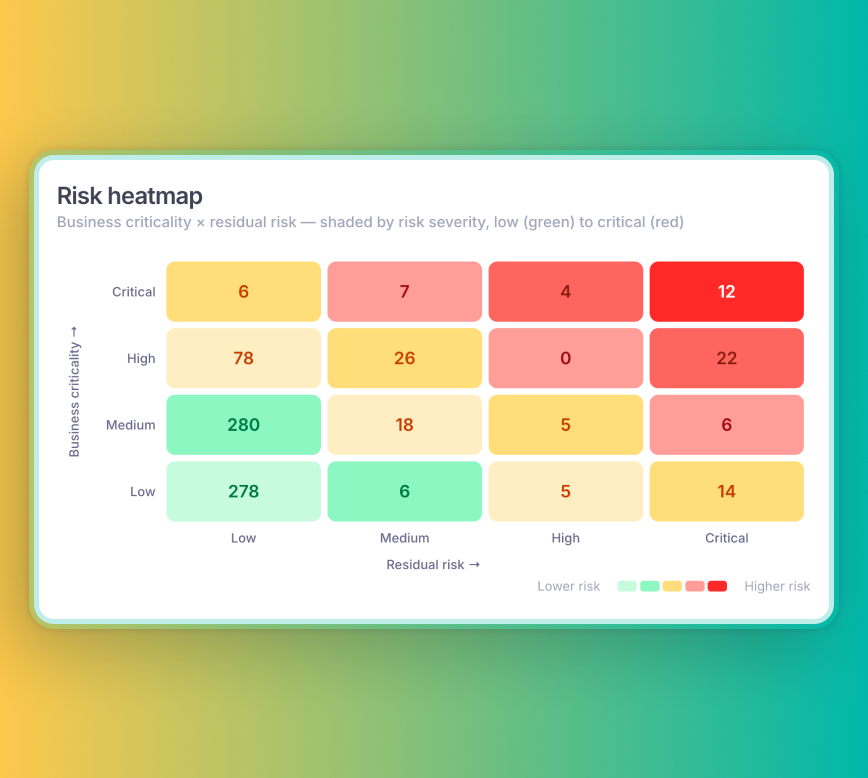

Stay on top of SaaS and AI risks without waiting for the next questionnaire or scheduled review. Nudge Security continuously recalculates app risk scores as vendor posture, usage, access, identities, integrations, and controls change.
Combine vendor security and supply chain insights with internal context about an app’s access and exposure within your environment, including OAuth grants, MCP connections, AI agents, authentication methods, security posture findings, and mitigating controls.
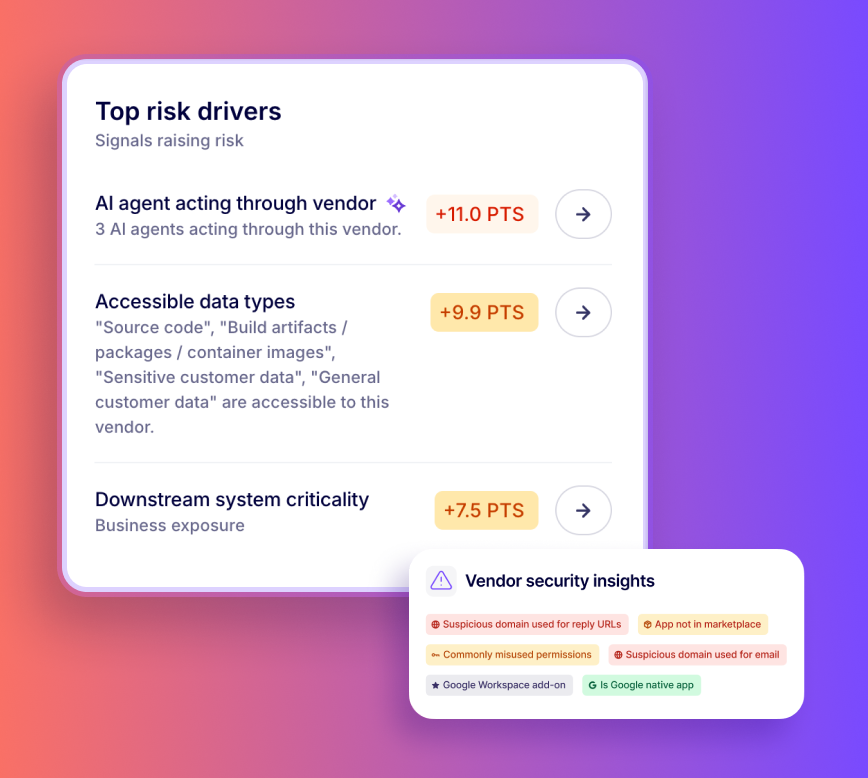
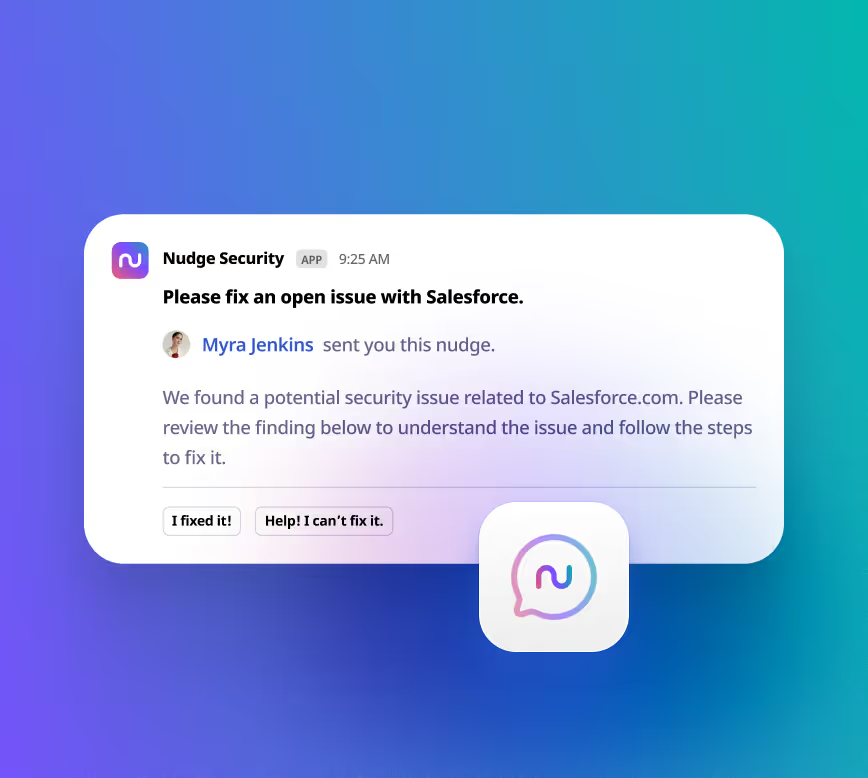
See which control gaps drive an app’s risk score and rank each intervention based on how much risk it could reduce. Adapt security decisions and mitigating controls as your risk posture changes.