Third-party risk management (TPRM) is the systematic process of identifying, assessing, and mitigating risks introduced by every external vendor, supplier, and service provider your organization depends on. It covers the full vendor lifecycle: initial risk assessment, continuous monitoring, contract governance, compliance validation, and offboarding. The scope extends beyond cybersecurity to include operational disruptions, regulatory compliance failures, financial exposure, and reputational damage.
As SaaS adoption has grown, TPRM has expanded from annual questionnaires to continuous monitoring across hundreds or thousands of external relationships—many of which carry direct access to your systems and data.
Key takeaways
- TPRM covers the full vendor lifecycle, from initial risk assessment through ongoing monitoring and eventual offboarding
- Third-party risk includes cybersecurity, operational, compliance, financial, and reputational categories—and they often intersect
- SaaS supply chain risk has become a distinct and urgent TPRM subcategory: every SaaS-to-SaaS OAuth connection is a potential vendor access pathway
- Regulatory pressure on TPRM is increasing: DORA, NIS2, SEC cybersecurity rules, and NYDFS all include explicit third-party risk requirements
- Effective TPRM requires continuous monitoring, not just point-in-time assessments, because the attack surface changes faster than annual reviews can track
- Fourth-party risk (the risk from your vendors’ vendors) is increasingly unmanageable without automated discovery and monitoring tools
TPRM vs. vendor risk management vs. supply chain risk management
Every organization relies on external parties. Cloud infrastructure, payroll processing, legal services, software tools, data storage, marketing platforms: the list extends into the hundreds for most enterprises. Each of those relationships introduces risk. If a payroll provider suffers a data breach, your employees’ personal data is exposed. If a core SaaS vendor goes down, your operations stop. If a supplier’s security practices violate a regulatory requirement, your compliance posture is implicated.
TPRM is how organizations get ahead of those exposures instead of reacting after the fact. It’s the structured process of understanding which external parties you depend on, what risks they introduce, how significant those risks are, and what controls are in place to manage them.
“Third-party risk management” is sometimes used interchangeably with “vendor risk management” or “supply chain risk management,” but they’re not identical. Vendor risk management typically focuses on procurement relationships: cost, performance, contract terms. TPRM has a broader mandate—cybersecurity, compliance, operational resilience, and reputational considerations alongside commercial terms. Supply chain risk management often refers specifically to physical supply chains. TPRM, as used in security and compliance contexts, covers all of it.
Why TPRM has become a board-level priority
Third-party risk has moved from a compliance checkbox to a board-level priority driven by three forces: high-profile supply chain breaches that demonstrated how vendor compromise cascades to customers, escalating regulatory requirements across the EU and U.S., and the explosion of SaaS vendor relationships that now extend well beyond what procurement tracks.
High-profile supply chain breaches. SolarWinds (2020) demonstrated that a trusted software vendor could become the entry point for a sophisticated nation-state attack affecting thousands of downstream organizations. MOVEit (2023) showed how a single vulnerability in a widely used file transfer tool could cascade into simultaneous breaches across hundreds of organizations. These incidents made vendor risk concrete in a way that compliance frameworks never had.
Regulatory escalation. Financial services regulators, in particular, have hardened their requirements. The EU’s Digital Operational Resilience Act (DORA) requires financial institutions to maintain detailed inventories of all third-party technology providers and demonstrate active monitoring. NIS2 extended cyber risk requirements to supply chain relationships across essential sectors. The SEC’s cybersecurity disclosure rules affect how material third-party incidents must be reported. NYDFS Part 500 explicitly addresses third-party service provider security. Organizations without mature TPRM programs are increasingly in direct regulatory exposure.
SaaS complexity. The shift to cloud-based services means most organizations now have far more vendor relationships than they realize. Legacy TPRM programs tracked major contracts and strategic suppliers. Modern SaaS adoption means a single department can introduce dozens of third-party relationships in a quarter—most of them never reviewed by security or procurement.
Types of third-party risk
TPRM programs need to cover multiple risk categories, because vendor relationships fail in different ways.
Cybersecurity risk
The vendor gets breached and attacker access cascades to your environment. Or the vendor stores your data insecurely. Or their application has vulnerabilities that expose your users. Cybersecurity is typically the highest-priority TPRM category because it’s both common and consequential.
Operational risk
The vendor experiences downtime, exits the market, or fails to deliver. If your operations depend on that vendor’s availability, their disruption is your disruption. Service-level agreements and business continuity provisions address some of this risk, but they don’t replace knowing which vendors are critical to operations.
Compliance and regulatory risk
Using a vendor that doesn’t meet applicable regulatory requirements can put your own compliance posture at risk. GDPR data processing requirements apply to third-party processors. HIPAA business associate agreements are required for healthcare-adjacent vendors. Financial regulatory requirements impose standards on technology providers. If your vendor can’t demonstrate compliance, your organization may be implicated.
Financial risk
A vendor in financial distress may be slow to address security vulnerabilities, may exit the market without transition time, or may accept cost-cutting practices that degrade their security posture. Financial health is a relevant TPRM input, especially for vendors delivering critical infrastructure.
Reputational risk
Vendor behavior reflects on the organizations they serve. A vendor involved in a high-profile ethics violation, environmental incident, or discriminatory practice creates reputational exposure for customers who continue using them. In regulated industries, this is often a compliance consideration as well.
SaaS supply chain risk
This is the category that’s grown fastest and that most TPRM programs are least equipped to handle. When employees adopt SaaS tools through OAuth connections—granting a marketing platform access to your CRM, or a productivity tool access to your email—each connection is a third-party access pathway. The vendor on the other end of that OAuth grant has access to your data until the grant is revoked.
The compounding problem is fourth-party risk: the SaaS tools you’ve authorized have their own integrations, creating chains of access that extend well beyond what any vendor questionnaire would reveal. A project management tool integrated with your HR system, which is in turn integrated with a payroll processor—each link in that chain represents exposure your TPRM program needs to account for.
The TPRM lifecycle
A TPRM program spans six stages: vendor identification, risk tiering and initial assessment, ongoing monitoring, contract governance, incident response, and offboarding. Each stage matters; most programs fail at the ones that happen after the initial assessment.
Vendor identification and inventory
Before you can manage third-party risk, you need to know who your third parties are. This is harder than it sounds. Formal procurement tracks major contracts, but SaaS adoption, freelancer relationships, and department-level tool purchases routinely create vendor relationships that bypass procurement review. A complete vendor inventory requires automated discovery in addition to contract management.
Risk tiering and initial assessment
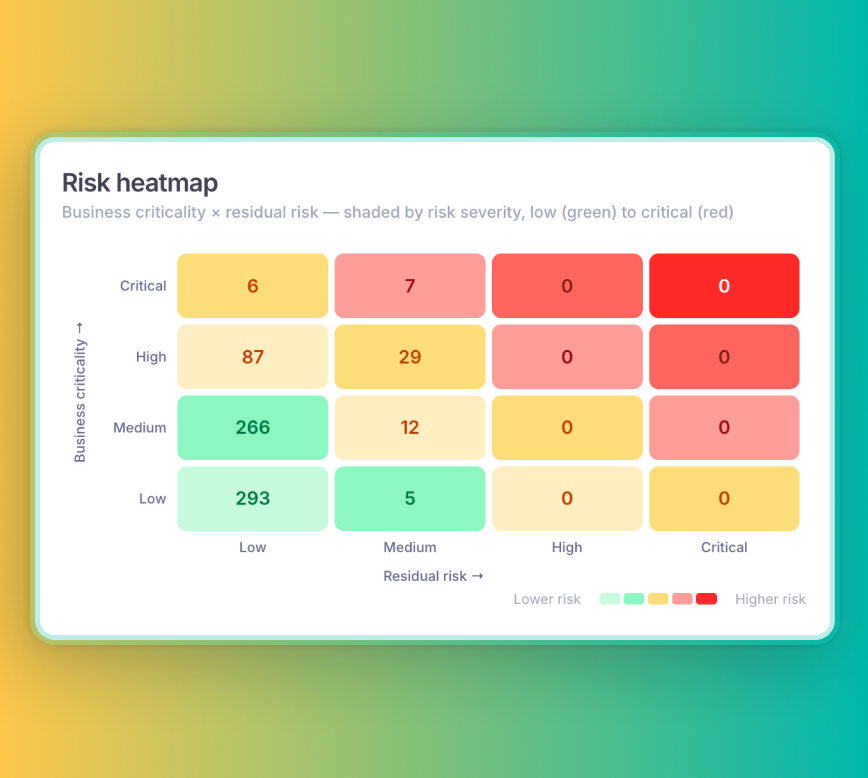
Not all vendors carry equal risk. A vendor with access to your production database is categorically different from a vendor providing branded office supplies. Risk tiering classifies vendors by criticality and exposure so you can apply appropriate assessment depth where it matters most.
Common tiering models use two to four tiers:
- Tier 1 (critical): Vendors with access to sensitive data, critical systems, or where failure would halt operations. Requires comprehensive assessment, documented controls, and ongoing monitoring.
- Tier 2 (significant): Vendors with meaningful data access or operational dependencies. Requires standard questionnaire, periodic review.
- Tier 3 (low): Vendors with limited access and low operational impact. Basic verification only.
Assessment methods vary by tier: detailed questionnaires and evidence reviews for Tier 1; shorter questionnaires for Tier 2; attestations for Tier 3.
Ongoing monitoring
Initial assessment is a point-in-time snapshot. Vendor risk changes continuously: new vulnerabilities surface, security certifications lapse, ownership changes, financial conditions deteriorate. Effective TPRM includes continuous monitoring that surfaces material changes without waiting for the next annual review cycle.
Monitoring mechanisms include automated feeds for cybersecurity ratings changes, alerts for vendor breach disclosures, and tracking of compliance certification status. The goal is early warning: catching a vendor’s deteriorating posture before it becomes your incident.
Contract and governance integration
TPRM findings need to be reflected in contractual terms. That means security requirements in vendor contracts, audit rights, incident notification obligations, data processing agreements, and exit provisions. Legal and security teams need to collaborate so that technical risk assessment translates into enforceable obligations.
Incident response
When a vendor suffers a breach or significant outage, you need a response playbook. Which vendors are critical? Who internally owns each relationship? What data was potentially exposed? What are the communication obligations to regulators, customers, and the board? Having answers prepared before an incident is the difference between a managed response and a scramble.
Vendor offboarding
When a vendor relationship ends, the access that vendor had should end with it. In practice, this rarely happens cleanly. OAuth connections persist after contracts end. Service accounts don’t get deprovisioned. Data shared with a vendor may remain in their environment after the business relationship has closed. Vendor offboarding is an underrated TPRM gap.
TPRM frameworks and regulatory standards
The most widely used TPRM frameworks are NIST SP 800-161, ISO 27001/27002, and DORA for financial services. Each provides tested structure and maps to different regulatory obligations. Most enterprise programs align with at least one.
- NIST SP 800-161 (Cybersecurity Supply Chain Risk Management): The most comprehensive U.S. government framework for supply chain risk, used widely in federal contexts and by organizations seeking a rigorous baseline.
- ISO 27001/27002: Includes third-party relationship management as a control domain; commonly used in enterprise certification programs.
- SOC 2: Requires vendors to demonstrate controls over subservice organizations; customer audits often extend TPRM requirements downstream.
- DORA (EU Digital Operational Resilience Act): Binding on EU financial entities; mandates specific TPRM requirements including vendor registers, contractual provisions, and oversight of critical ICT providers.
- NIS2: Extends cyber risk requirements to supply chains for organizations in essential sectors across the EU.
These frameworks exist because regulators recognized that vendor risk is organizational risk. Alignment gives programs a tested structure for managing risk—not just a checklist to clear for auditors.
SaaS supply chain risk: the new TPRM frontier
The fastest-growing segment of third-party risk is also the hardest to see: the SaaS supply chain.
Traditional TPRM was designed around structured vendor relationships: contracts, purchase orders, formal integrations. SaaS adoption doesn’t work that way. An employee can authorize a new AI tool in under a minute, creating a vendor relationship with data access before anyone in security or procurement is aware it exists.
Each OAuth authorization is a standing vendor access grant. Most organizations have thousands of them. The majority were never formally reviewed. Many belong to employees who have since left.
The fourth-party layer compounds this. When a SaaS tool your employees use integrates with another SaaS tool—a CRM connecting to an enrichment service, or a productivity app pulling from a project management platform—you’ve effectively authorized a fourth-party vendor relationship through a click someone made months ago.
This is the TPRM gap that’s hardest to close without purpose-built visibility tools. Manual vendor reviews and questionnaire-based programs can’t surface what they can’t find. Closing it requires continuous discovery of SaaS-to-SaaS connections, automated risk assessment of OAuth grants, and monitoring that surfaces new connections as they’re created.
Employees adopting unsanctioned tools aren’t trying to create security gaps—they’re trying to get work done. A TPRM program that recognizes this and provides fast-track approval workflows closes the gap more effectively than one that relies on restrictions.
How Nudge Security addresses SaaS supply chain risk
Nudge Security was built to solve the visibility problem at the foundation of modern TPRM. Traditional TPRM tools start with a vendor list—but if the list is incomplete, the program has a gap it can’t close.
Nudge Security provides Day One discovery of every SaaS app and OAuth connection in use across your organization, including those created without IT review, with no network configuration required. This closes the SaaS vendor inventory gap that most TPRM programs can’t solve through questionnaires alone. Nudge covers 175,000+ apps, giving security teams a complete view of which vendors have access to your data and through what OAuth connections. Every grant is mapped: what app holds it, what scopes it carries, when it was created, and who created it.
For supply chain breach response, Nudge monitors third-party security incidents and surfaces alerts when a connected vendor is compromised—so you can immediately assess exposure and trigger revocation workflows rather than discovering the breach through a news headline weeks later.
Nudge also addresses the offboarding gap: when an employee leaves, Nudge surfaces every SaaS tool and OAuth grant associated with their identity, enabling fast, complete revocation rather than leaving stale vendor access to persist indefinitely.
For organizations working toward DORA, NIS2, or SOC 2 compliance, Nudge’s continuous monitoring and audit trail provide the evidence of active TPRM that point-in-time questionnaire programs can’t.
See how Nudge Security maps your SaaS vendor relationships. Start a free trial.